Research paper
In-Vehicle Illegal Parking Detection Using Video Analysis and GIS Data with Human-in-the-Loop Fine Ticketing
J. Benić, A. Janjić, D. Ševerdija, D. Matijević
Most mobile enforcement is assembled from smart cameras bought off the shelf, which analyze on board and are then integrated into someone’s system. We designed the whole unit ourselves: the camera inside the vehicle, the edge computer, the positioning, the models and the software the officers use.
In service with the municipal enforcement of the City of Osijek, as part of its wider parking enforcement system.
Tvrđa · pedestrian zone
Every street, one patrol
Vehicle
7:00
Zone covered
On foot
31:00
Estimated for the Tvrđa pedestrian zone from the covering route and from data provided by the City of Osijek’s wardens.
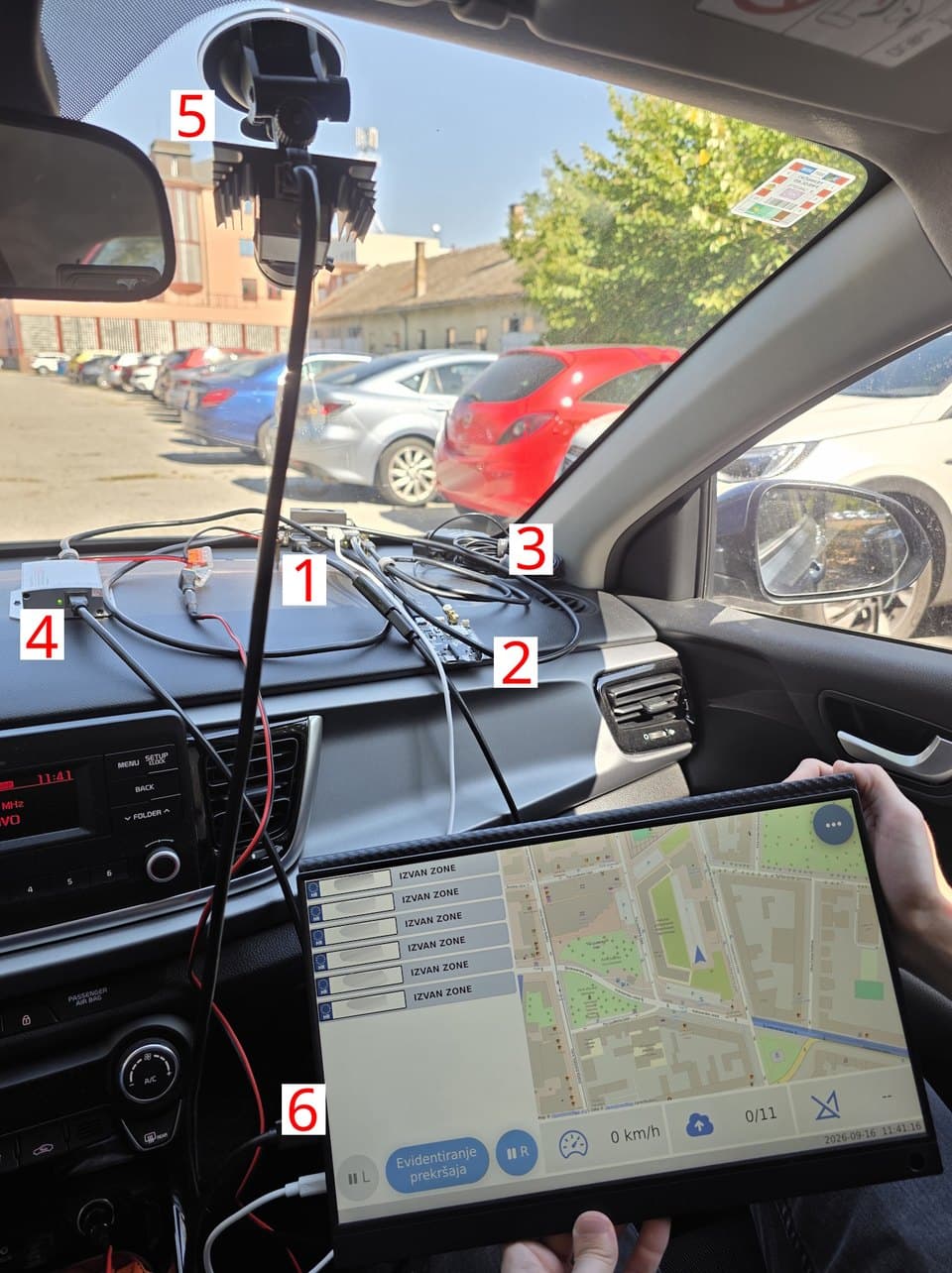
Hardware
The camera is an industrial sensor with no analytics of its own. Everything it sees is processed by our software on the edge computer beside it, in the vehicle, as it drives.
Edge computer
NVIDIA Jetson Orin NX, 16 GB, with LTE
RTK positioning module
Satellite position with RTK corrections
GNSS antenna
For the positioning module
PoE injector
Power and data for the camera
Industrial camera
Inside the vehicle, behind the windshield
Officer’s display
Touch screen with our in-vehicle interface
Nothing mounted on the roof, and no smart camera bought in. Because every layer is ours, we can change any of them: a new model, a new rule, a new zone, without waiting on a vendor.
Four steps, two of them in the car and two on the server.
The industrial camera streams at 25 frames per second. The edge computer processes it on board, on a 15 watt power budget.
A YOLO26 detector finds vehicles and plates in about 18 ms. A compact transformer reads each plate in about 7.5 ms. Readings over two seconds are combined to suppress errors.
RTK positioning attributes every detection to a zone drawn on our map, with the rule that applies there. Outside regulated zones the models do not run at all.
The officer in the car triages. Permit holders are filtered out automatically. A back-office officer makes the final decision in the web application.
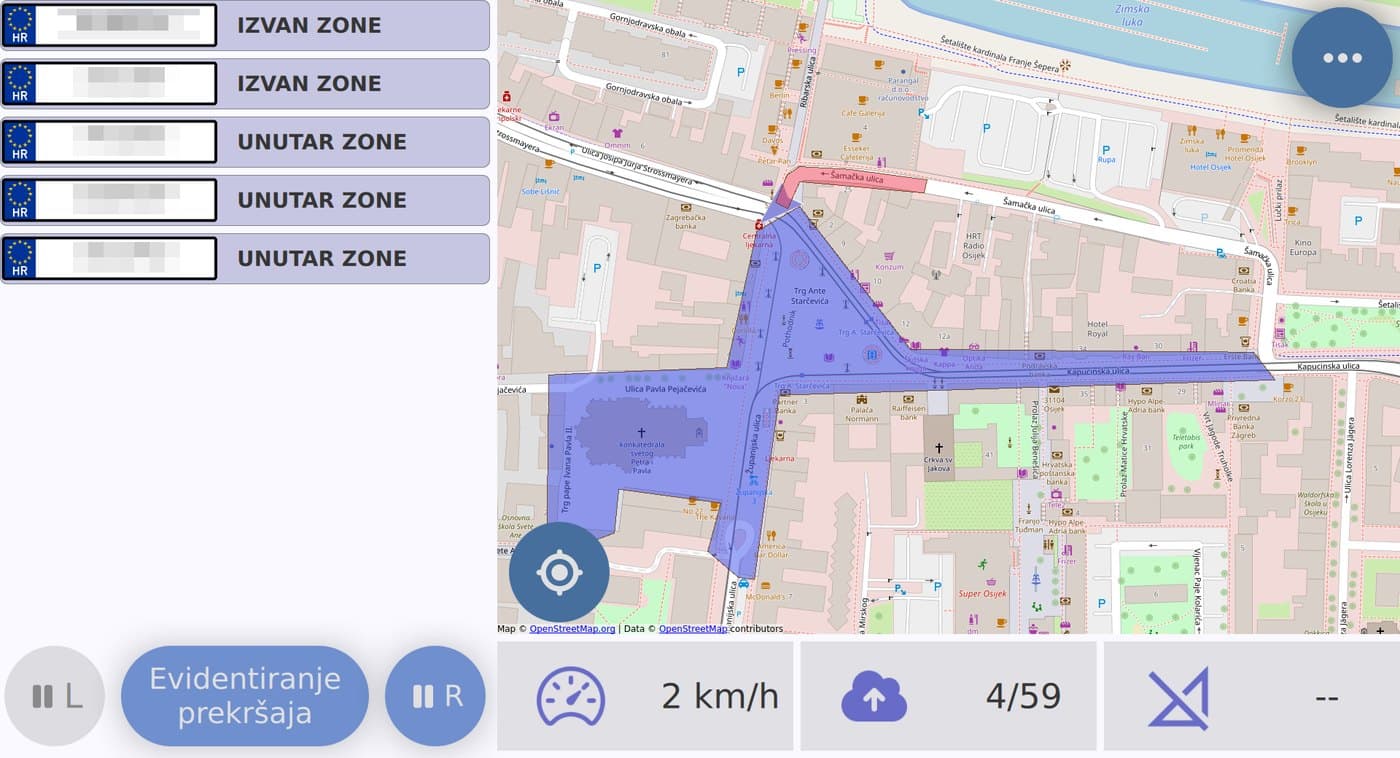
In the car
Every plate read along the way is listed as inside or outside the regulated zone, beside a live map of the route. The zone itself is shaded on the map.
When a violation happens outside the defined zones, the officer can switch detection on for every frame with a single button.
Human in the loop
Every ticket is backed by evidence that has passed a triage in the vehicle and a decisive review in the back office. The reviewer decides on the evidence, and has the authority to reject what the model suggests.
This keeps the system within Article 22 of the GDPR and the human oversight provisions of the EU AI Act, and it catches model errors before they reach a citizen.
Dwell time verified across repeated passes, where a single pass is not enough.
Public transport as continuous coverage of the street network, at no extra patrol cost.
Each vehicle placed in its own parking bay, from plate geometry and the patrol car’s heading.
Research paper
J. Benić, A. Janjić, D. Ševerdija, D. Matijević
The unit fits an ordinary municipal car. We can drive it through your zones and show you what it sees.