Products · MII Vision Platform

MII Vision Platform

A video core we built ourselves, a geospatial layer that gives every event a place, and AI adapters written for the situation in front of you. One system, running wherever you decide.

How it fits together

Existing cameras stay where they are. Everything above them is ours.

Signal flows left to right. Existing street, PTZ, gate and yard, and mobile cameras feed the video core, which MII built: it ingests streams from any make, handles recording and retention, users, roles and the audit trail, and runs on your hardware. Above it, the geospatial layer adds coordinates, zones and map-ready events, and AI adapters add detection, rules and behavior. What comes out goes to an operator console, case files and the software you already use.

  1. Existing

    Cameras

    • Street cameras
    • PTZ cameras
    • Gate and yard
    • Mobile units
  2. MII core

    Video core (VMS)

    Built by MII
    • Stream ingest, any make
    • Recording and retention
    • Users, roles, audit trail
    • Runs on your hardware
  3. MII layers

    Geospatial layer

    Coordinates, zones, map-ready events

    AI adapters

    Detection, rules, behavior

  4. Output

    What you get

    • Operator console

      map, live, review

    • Case files

      evidence, export

    • Your systems

      events sent to the software you use

MII Vision Platform architecture. Existing cameras stay where they are; the core and the layers above them are ours.

Layer 01

Video core

Cameras from different manufacturers, bought in different years, under different contracts, all in one system. One place to look, one set of permissions, one audit trail.

We wrote this core ourselves rather than building on someone else’s. That is not a feature we sell. It is the reason we can put anything on top of it, including a detector that exists nowhere else because nobody has needed it before.

Layer 02

Geospatial layer

Every camera has a position and a field of view. Every detection inherits a coordinate. What comes out is not a clip and a timestamp, it is an event at a place.

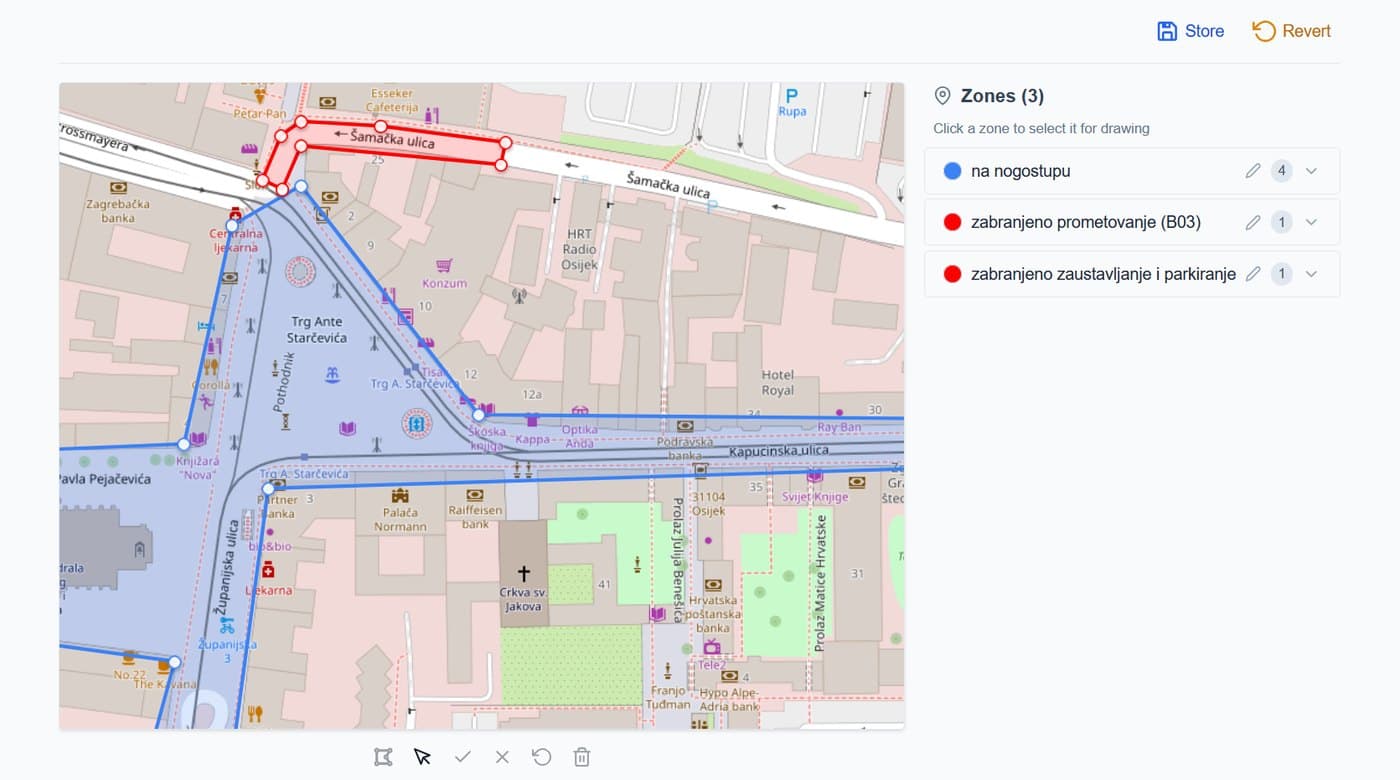
Zones are drawn directly on the live map in the platform, and each carries the rule that applies inside it, so a detection knows which regulation it may have broken.

Zone editor in the platform: three zones drawn over a map of central Osijek, each with its own regulation
Drawing zones in the platform. Each zone carries its own rule: no parking on the sidewalk, no entry, no stopping.

Layer 03

AI adapters

An adapter is a detector written for one job. It runs on the cameras you already have, inside one platform. The list below is not closed. If the event matters to you and a camera can see it, we can build an adapter for it.

Two ways to build an adapter

Which one we use depends on the question you are asking of the camera. A clearly defined object calls for one approach, behavior and context for the other.

Specialized detectors

In production

Fast and efficient

A model trained for one job: a vehicle class, a license plate, a pallet, a pile of waste. Detection with the YOLO family and tracking with ByteTrack, so every object keeps its identity over time.

  • Runs in real time, on modest hardware and at the edge
  • Highly predictable once calibrated on site
  • Needs footage of the event to learn from
  • For a clearly defined object, weeks from definition to production

Best for: events you can name in advance and see clearly.

ask › Is anyone inside the depot yard after hours?

Vision transformers and vision-language models

Flexible, for harder questions

Models that read the whole scene instead of looking for a single object class. They can take on a question such as “is something unusual happening here” without that class being defined in advance.

  • Understands behavior and context, not only objects
  • Suited to situations that are hard to describe as one object
  • The price is heavier computation and a different kind of error
  • A longer path to production, and we say so up front

Best for: behavior, context and situations that do not fit a single object.

The two can work together. A fast detector watches every frame, and the heavier model looks closer only when something has been flagged. Our mobile unit already works in two stages: a YOLO26 detector finds the plate, and a compact transformer reads it.

  1. Stage 1

    A fast detector

    Watches every frame

  2. Stage 2

    A heavier model

    Looks closer only when something is flagged

In production
Running today, on real sites, under real conditions. Where you see this mark on this page, we can show you the system doing it.
Built on request
Within reach of the same platform and the same team, built for your site and your data. We say which is which, on purpose.

For industry and logistics

Four areas where it is usually worth starting. Most sites pick two or three detectors first, and add the rest later on the same cameras.

People safety

  • Protective equipment: helmet, vest, glasses

  • Entry into a restricted or hazardous zone

  • A person in the path of machinery or forklifts

  • Work at height without protection

  • Person down

Property

  • Unauthorized entry outside working hours

  • A person or vehicle lingering in a zone

  • Removal of material, fuel or metal

  • A vehicle on site that was never announced

Process and logistics

  • Plate reading at the gate, the exit and the weighbridge

  • Counting and classifying vehicles

    In production
  • Queue length and dwell time in the yard

  • A stoppage or a foreign object on a belt

Environment and incidents

  • Early smoke and fire detection

  • Dust and spillage

  • Waste dumped on site

    In production
  • A zone that no longer looks the way it usually looks

The list is not closed. The model is trained for the event you define. Vandalism, an altercation, an abandoned object, a queue that should not exist.

For cities and utilities

Every case arrives located, with its evidence attached, ready for the officer who has to act on it.

In production

Parking and traffic enforcement

Plate reading, and stationary vehicle violations in pedestrian zones, on crossings and in disabled bays. From fixed cameras, or from our own unit inside a patrol vehicle.

In production

Illegal dumping

New piles beside containers, at recycling points and at collection yards, recognized as they appear, with a time-stamped record that stands up as evidence.

In production

Traffic counting and analytics

Vehicles by category, plus pedestrians and cyclists, with load by hour, day and location. The numbers a traffic study needs, collected continuously instead of once.

Built on request

Pedestrian zones

Crowd density and flow of people, occupancy in real time, alerts on anomalies, and graffiti appearing on a facade.

How a new adapter is made

The path is the same for every new event type. There is no stage where you do not know where the project stands.

  1. 01

    Definition

    Together we describe what the event is, when it counts as a breach, who gets told and how fast.

  2. 02

    Data

    Footage from your cameras, at your locations, in your light, dust and weather.

  3. 03

    Training or configuration

    A specialized detector is trained on that footage, a transformer-based adapter is configured and tested on it. Either way the threshold is tuned on site.

  4. 04

    Production and retraining

    It runs, and it keeps learning from the cases your operators confirm or reject.

With a specialized detector and a clearly defined object, a pallet or a license plate, the path from definition to production is measured in weeks. For behavior, where transformer models do the work, it is longer, and we will not promise a speed we cannot deliver.

The system reports, a person confirms. Nothing has a consequence until the person responsible has seen the footage and confirmed it.

Deployment

You decide where it runs

Some clients want every stream and every model inside their own network, on machines they own. Others would rather we host it and stay out of their server room. The platform is the same either way, and there is no per-camera subscription running in the background.

  • On premises

    Servers in your own room

  • Edge

    Processing at the camera

  • Hosted by us

    If you would rather not run it

  • GDPR by design

    Retention and roles you set

Case study · City of Osijek

40+

cameras on the platform, in production since October 2025

The same platform runs the city’s enforcement every day.

Video core, geospatial layer and adapters, working together on real streets: every case located, documented and handed to the department responsible for it.

Read the Osijek case study

See it on your own cameras

We come with a laptop and a map of your area. An hour is usually enough to tell whether this is worth your time.